
Lionel Messi – World Cup Superstar and Eternal Legend
For more than two decades, Lionel Messi has been the defining figure of modern football: a playmaker, goalscorer, leader, and global icon whose influence stretches far beyond any single club or tournament. At World Cup level, he evolved from a precocious teenager in 2006 into the captain who finally lifted the trophy for Argentina in Qatar, completing a legacy that now sits alongside the greatest names in the history of the sport. As one of the headline names in the Superstar cluster of Players and Legends, Messi’s story is the template for how talent, longevity, and big‑tournament performance combine to create a true superstar.
Early World Cups: From Prodigy to Focal Point
Messi’s World Cup journey began at Germany 2006, when he arrived as a teenager already tagged as Maradona’s heir but still fighting for minutes in a veteran Argentina squad. He scored and assisted in limited appearances, hinting at what he could become on the biggest stage, yet finished the tournament mostly as an impact substitute rather than the undisputed main man.
By 2010 in South Africa, the dynamic had changed: Messi was now Argentina’s attacking focal point, carrying Ballon d’Or‑level status from his club career into the national team. The tournament, however, did not fully match his reputation; despite flashes of brilliance in build‑up and chance creation, he failed to score, and Argentina exited heavily to Germany in the quarterfinals. It was the first reminder that even the most gifted individuals can be constrained by team structure, tactical imbalance, and the unique pressure of World Cup football.
Brazil 2014: Carrying a Nation to the Brink
Brazil 2014 became the moment when Messi’s World Cup narrative shifted from potential to historic impact, even without the trophy. Operating in a team built to protect him and to counter through his creativity, he scored four goals in the group stage and delivered decisive contributions all the way to the final, including iconic late winners and long‑range strikes that rescued tight matches.
Although Argentina ultimately fell short against Germany in extra‑time, Messi was awarded the Golden Ball as the tournament’s best player, reflecting his central role in carrying the team to within a few kicks of the title. For many observers, this tournament established him as not just a club icon but a genuine World Cup leader, even if the greatest prize still eluded him.
Russia 2018: A Difficult World Cup in Transition
Russia 2018 represented a turbulent chapter in Messi’s World Cup story, marked by tactical confusion, defensive instability, and managerial upheaval around him. Argentina struggled through the group stage, and Messi’s moments of brilliance—most notably a superbly controlled finish against Nigeria—felt more like individual rescue missions than the product of a coherent game plan.
The round‑of‑16 defeat to France highlighted both sides of Messi’s reality at that moment: he produced assists and dangerous involvement between the lines, yet Argentina’s chaotic structure left them unable to contain a younger, faster opponent. For critics, Russia 2018 reinforced the narrative that Messi’s national‑team career might end without a World Cup, while for supporters it underlined how much he was being asked to do in an imperfect context.
Qatar 2022: Completing the World Cup Legacy
Qatar 2022 transformed Messi’s World Cup legacy from “nearly” to “completed” in the most dramatic way possible. Across seven matches, he scored seven goals and provided three assists, contributing directly to ten goals and influencing almost every attacking phase Argentina produced. He scored in the group stage, the round of 16, the quarterfinal, the semifinal, and twice in the final, delivering a level of consistency rarely seen from a single player across an entire tournament.
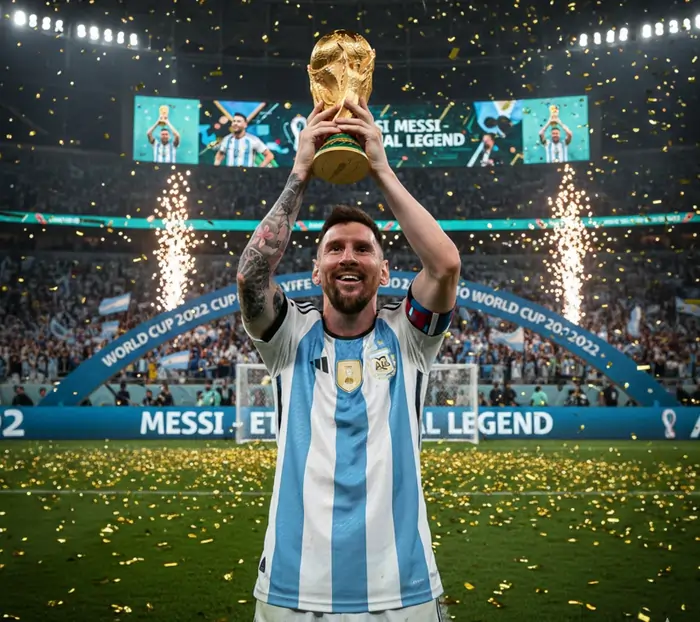
In the final against France, Messi’s brace and involvement in build‑up helped Argentina in one of the most chaotic and high‑pressure matches in World Cup history. After 3–3 across 120 minutes, the shootout victory allowed him to finally lift the trophy, a moment that instantly became one of the iconic images of the sport. He was again awarded the Golden Ball, becoming the first player in history to win the award twice, and setting records for most World Cup appearances and total goal contributions (goals plus assists) in the competition’s history.
Lionel Messi – World Cup Stats and Records
Viewed purely through numbers, Messi’s World Cup record underlines why he belongs at the center of any Superstar discussion. Across five tournaments (2006, 2010, 2014, 2018, 2022), he has played 26 World Cup matches, scoring 13 goals and providing eight assists, giving him 21 direct goal contributions—more than any player in the competition’s history.
He holds or shares several major World Cup‑related distinctions: most appearances at the tournament, first player to score in every knockout round from the last 16 to the final in a single edition, and a joint record with Pelé for combined goals and assists at World Cups. For Argentina, he is also the national team’s all‑time leading scorer, surpassing long‑standing records and adding World Cup qualification milestones to his major‑tournament output. These numbers are not just impressive in isolation; they show how his international career evolved from promise to sustained dominance across multiple cycles.
Style of Play: Playmaker, Finisher, and Leader
Beyond the statistics, Messi’s World Cup performances are defined by his unique blend of roles: he is simultaneously a primary playmaker, a goal threat, and a connector between midfield and attack. In his early tournaments, he operated more as a dribbling winger, receiving wide and attacking the half‑space with quick combinations; over time, he dropped deeper, becoming the conductor who dictates tempo, switches play, and finds final‑third passes others cannot see.
Qatar 2022 showcased his matured profile: less reliant on constant sprints, more focused on timing, positioning, and decisive actions in key moments. His assists—such as the disguised pass for Nahuel Molina against the Netherlands and the driving run and cut‑back for Julián Álvarez versus Croatia—illustrated how he compensates for reduced physical output with even greater efficiency of contribution. Combined with his penalty taking, shooting from the edge of the box, and ability to draw defenders to create space for teammates, this multifaceted style makes Messi one of the most tactically influential players the World Cup has seen.
Club and International Context
Messi’s World Cup story cannot be separated from his wider career, where he has accumulated an extraordinary haul of club trophies, Ballon d’Or awards, and individual scoring records. His years at Barcelona, where he broke records for goals, assists, and Champions League performances, laid the foundation for the expectation that he would eventually dominate on the international stage as well. Later chapters at Paris Saint‑Germain and Inter Miami added new contexts, but his World Cup triumph with Argentina became the central symbolic achievement that aligned club greatness with national‑team glory.
For Argentina, his record of more than 100 international goals and a full set of major trophies—including Copa América titles, an Olympic gold medal, and the World Cup—means he now stands as the clear statistical and symbolic leader of his country’s football history. Where earlier generations debated Maradona versus other legends, the modern conversation inevitably includes Messi at or near the top of any ranking of Argentine and global greats.
Legacy Among the Game’s Greatest
In the wider history of the World Cup, Messi’s legacy now sits in the same breath as Pelé, Maradona, and the most iconic tournament performers. He combines longevity (five World Cups), consistency (goals and assists across multiple editions), and a climactic title‑winning run that delivered one of the most memorable finals in the competition’s history.
