
Africa
Africa’s national teams arrive at FIFA World Cup 2026 in a completely new landscape: nine direct places, one playoff route, and a qualification campaign designed to test depth, discipline, and consistency across the continent. This page is your hub for understanding how CAF’s path works, which nations have already secured their spots, and how African football is evolving tactically as it steps into its biggest World Cup presence ever.
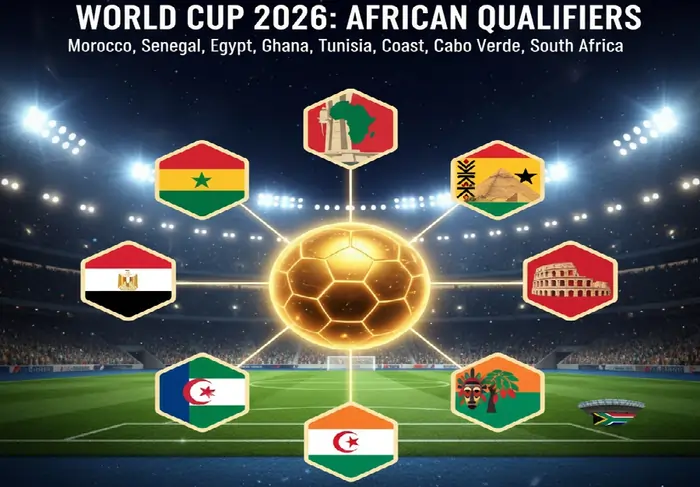
CAF’s new format: nine tickets, one golden playoff
For World Cup 2026, Africa moves from five guaranteed slots to nine, with the possibility of a tenth through the inter‑confederation playoffs. To handle that expansion, CAF redesigned its qualifiers around a single, large league‑style phase followed by a focused playoff.
- First round: nine big groups
All 54 CAF member associations were drawn into nine groups of six teams.
Each group plays a home‑and‑away round‑robin, giving every nation 10 matches – far more than in previous cycles – against a variety of opponents. - Group winners qualify directly
The winner of each group earns an automatic place at World Cup 2026. - Playoffs for a potential 10th place
After the group stage, the four best runners‑up (based on points and tiebreakers) enter a mini playoff tournament to decide which team represents Africa in the inter‑confederation playoff.
This structure does two key things: it gives teams more competitive games to develop over time, and it keeps the race alive for strong nations who finish just short of top spot. There’s no “easy” road; to reach North America, African sides need to perform across an entire league campaign, not just a handful of matches.
The nine African nations heading to World Cup 2026
By the end of CAF’s group phase, nine teams had topped their groups and confirmed their places at the World Cup. The list underlines both tradition and change:
- Morocco
- Senegal
- Algeria
- Tunisia
- Egypt
- Ivory Coast (Côte d’Ivoire)
- Ghana
- Cape Verde (Cabo Verde)
- South Africa
These nine direct qualifiers reflect a balance of established heavyweights and rising forces. Morocco, Senegal, Algeria, Tunisia, Egypt, Ivory Coast, and Ghana have long histories in World Cup and AFCON competition, while Cape Verde and South Africa add different types of stories: a historic debutant and a co‑host from 2010 returning to the global stage.
Each of these teams brings its own identity:
- Morocco, fresh from a 2022 semifinal run, combine disciplined defensive structures with quick, technically sharp transitions.
- Senegal blend athletic power, organised pressing, and experienced European‑based talent in key positions.
- Ivory Coast and Algeria offer deep pools of technically gifted players capable of playing both possession and transition football.
- Egypt and Ghana carry rich World Cup histories, passionate support, and tactical approaches that have adapted over multiple generations of players.
- Cape Verde’s group‑topping campaign shows how smaller nations can thrive in a long league format when they have clear plans and consistent execution.
- South Africa’s return underscores the benefits of domestic investment and continuity at national‑team level.
From The World Cup News Africa hub, you can click into team‑specific pages for Morocco, Senegal, Algeria, Tunisia, Egypt, Ivory Coast, Ghana, Cape Verde, and South Africa to follow tactics, squads, and match‑by‑match coverage more closely.
The playoff quartet: fighting for a possible 10th place
With nine direct qualifiers confirmed, CAF’s story for World Cup 2026 doesn’t end there. The four best runners‑up across the nine groups earned a second chance via an African playoff mini‑tournament.
That playoff lineup consists of:
- Nigeria
- Cameroon
- DR Congo
- Gabon
All four are serious football nations with histories of producing top‑level talent and strong AFCON performances. In this mini‑tournament:
- Two semifinals are played (1 vs 4, 2 vs 3), in a centralised location.
- The winners meet in a one‑off final.
- The playoff champion earns a place in the inter‑confederation playoff, facing opponents from other confederations for one of the last two World Cup spots.
That means Africa could send a tenth team to the finals if its playoff winner successfully navigates that inter‑confederation bracket.
Tactical evolution: Africa as standard‑setter, not outsider
Africa’s expanded role at World Cup 2026 is more than a numbers story; it reflects how the continent’s football has evolved tactically and structurally.
Several trends stand out:
1. Defensive organisation and compactness
Morocco’s 2022 run showcased what a highly-organised African team can do against elite opposition, and many other CAF sides have taken note. In this cycle, average defensive compactness and spacing between lines have improved across several top African teams, making them harder to break down and less reliant on purely reactive football.
Senegal, Tunisia, South Africa, and Cape Verde are examples of teams that maintain clear defensive structures while still being ready to spring counters when opportunities appear. This balance keeps them competitive in both qualifying and tournament‑style football.
2. Coordinated pressing and transitions
More CAF teams now use coordinated pressing as a deliberate tool, not just as individual bursts of effort. That includes high pressing in certain match phases, mid‑block traps to regain the ball, and rapid transitions aimed at exploiting the spaces left by opponents.
Morocco, Senegal, Algeria, and Ghana have all shown the ability to shift between more proactive pressing and compact containment, depending on opponent and game state. That kind of tactical flexibility is critical when facing diverse styles at a World Cup, from European positional play to South American transitional chaos.
3. Better use of depth and diaspora talent
Another key change is how African national teams are using their depth. Many squads now draw on large pools of players based in top European and domestic leagues, giving coaches more options to rotate across a 10‑match qualifying group.
Ivory Coast, Senegal, Algeria, Morocco, and Ghana all lean on diaspora talent and strong domestic foundations, creating squads that can handle injuries, suspensions, and tactical tweaks without losing coherence. Over a long qualification schedule, that depth often makes the difference between fading and finishing strong.
Why nine (or ten) African teams changes World Cup 2026
Africa’s guaranteed nine places – plus a possible tenth via playoff – significantly changes the shape of World Cup 2026. It means:
- More African presence in the group stage
With at least nine African sides, there will be multiple groups featuring strong CAF teams, including potential “groups of death” where African champions share a section with European or South American giants. - More chances for deep runs
The probability of at least one African team reaching the quarterfinals or semifinals increases when more nations participate, especially given recent progress in tactics and player development. - More diversity of styles
From Morocco’s disciplined block to Senegal’s balanced aggression, from Cape Verde’s compact, counter‑based approach to Egypt’s controlled, possession‑leaning game, Africa adds a wide range of football identities to the tournament. - Higher stakes for development at home
Each World Cup qualification amplifies domestic interest, sponsorship, and youth development. With nine or ten teams involved, the ripple effects across African football over the next decade could be enormous.
Follow every CAF national team story
The Africa (CAF) national teams hub at The World Cup News is designed to keep all of these threads in one place. From here you can:
- See which African nations have qualified and how they performed across their 10‑match group campaigns.
- Understand how CAF’s nine‑slot format and four‑team playoff shape the race to World Cup 2026.
- Dive into deeper profiles for Morocco, Senegal, Algeria, Tunisia, Egypt, Ivory Coast, Ghana, Cape Verde, South Africa, and the playoff contenders Nigeria, Cameroon, DR Congo, and Gabon.
- Track how African tactical trends – defensive structure, pressing systems, and squad rotation – carry over from qualifiers to the finals in North America.
As CAF’s playoff mini‑tournament plays out and the final list of African participants is set, this page will update with new context, links, and analysis, helping you follow Africa’s most significant World Cup campaign in history from start to finish.
