Europe
European national teams sit at the center of almost every World Cup conversation, and World Cup 2026 will be no different. UEFA has 16 places at the expanded 48‑team tournament, making it the single most represented confederation in North America. That doesn’t mean qualifying is easy; it means more nations are thrown into a long, tactical, and unforgiving race for tickets to the finals.
This page is your guide to Europe’s side of that journey: how qualification works, which countries are already in, which are still fighting through playoffs, and what kinds of tactical and generational shifts define the continent heading into 2026.
How UEFA qualifying works for World Cup 2026
Europe’s path to 16 World Cup spots runs through a two‑stage structure: a group stage and a playoff phase.
- 12 qualifying groups
UEFA created 12 groups, mostly of four teams, playing home‑and‑away in a round‑robin format from March 2025 through late 2025. - Group winners qualify
The 12 group winners secure direct qualification for the World Cup. - 16‑team playoffs for the final four spots
The 12 group runners‑up are joined by four of the best UEFA Nations League group winners who didn’t finish in the top two of their qualifying group. Those 16 teams are split into four “paths”, each with semifinals and a final, and each path winner claims a World Cup spot.
In numbers, that means: 12 direct slots from the group winners, plus four from the playoff paths, giving Europe its total of 16.
The design keeps the pressure high. Even strong sides that stumble early in their groups must navigate a playoff route where one bad night – or one penalty shoot‑out – can send them home.
Who’s already in: Europe’s core contenders
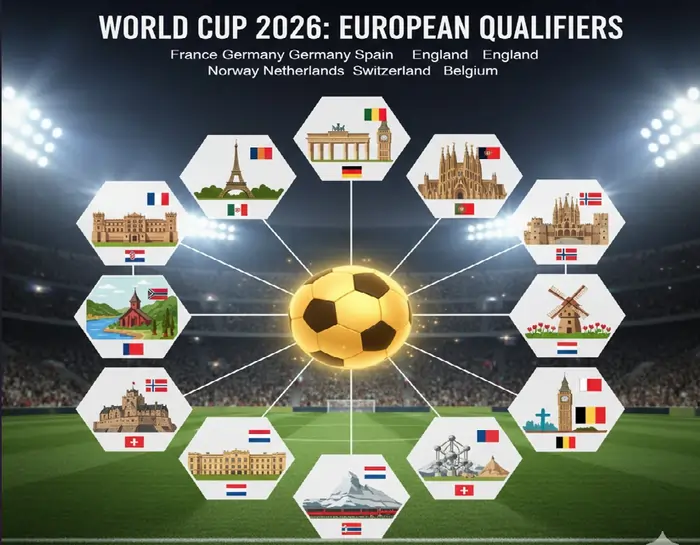
By the time the group stage wrapped up, 12 European countries had secured their World Cup tickets as group winners. That list reads like a who’s who of modern international football:
- France
- Spain
- Portugal
- England
- Germany
- Netherlands
- Belgium
- Norway
- Croatia
- Switzerland
- Austria
- Scotland
These teams cover a mix of World Cup winners, recent finalists, and rising forces. France and Spain bring deep, technically gifted squads capable of playing proactive football in almost any context. England and Germany arrive with major‑tournament expectations and fanbases that measure success in semi‑finals and finals, not just participation.
The Netherlands and Croatia fit a more tactical archetype: disciplined structures, high football IQ, and enough creativity to compete with anyone even when they don’t dominate the ball. Belgium, Austria, Switzerland and Norway round out a group of nations that mix experienced cores with new generations, making them capable of both upsets and deep runs.
From this Europe hub, you can drill down into specific national team pages (for example, France, England, Germany, Spain, Netherlands or Belgium) to see how each squad is evolving in the build‑up to 2026: who’s emerging, who’s fading, and how tactical ideas are shifting from one tournament cycle to the next.
Playoffs: the last four tickets and constant jeopardy
Not every strong European team tops its group. For some, the path to North America runs through the playoff system, which remains one of the most unforgiving mechanisms in international football.
The 16‑team UEFA playoff pool includes:
- All 12 group runners‑up.
- The four highest‑ranked UEFA Nations League group winners who failed to finish in the top two in their groups.
Those 16 teams are then drawn into four paths (A, B, C, D), each path containing four teams. Each path features:
- One‑legged semifinals.
- A one‑off final between the semifinal winners.
The winner of each path goes to the World Cup; everyone else stays home.
Some big names have already dropped into this zone in past cycles, and 2026 is no exception. For fans, this means more high‑stakes, knockout‑like games even before the World Cup begins. For coaches, it means planning an entire cycle knowing that a single 90‑minute match in March 2026 might decide whether their work is considered a success or a failure.
Tactical and generational trends across Europe
With so many top‑level national teams competing for 16 spots, Europe has become a kind of tactical laboratory for the modern game. Several trends stand out as we head toward World Cup 2026:
1. Flexible back lines and hybrid shapes
Many leading European sides are shifting seamlessly between back four and back three structures within the same match. For example, a nominal 4‑3‑3 can become a 3‑2‑5 in possession, with a fullback stepping into midfield and wide attackers pinning opposition fullbacks high.
This allows teams like France, Spain, Portugal, England, and the Netherlands to maintain numerical superiority in key zones while still protecting against counters. It also demands extremely intelligent defenders who can handle space and 1v1 situations without constant cover.
2. Pressing as a default, not a “special plan”
Across UEFA, high and mid‑block pressing has become standard rather than exotic. Even teams outside the traditional elite have adopted structured pressing schemes, trying to disrupt build‑up early instead of dropping into low blocks and simply hoping to survive.
In qualification, this often shows up in pressing metrics: recoveries in the opposition half, forced long balls, and shot volume generated from turnovers. At the World Cup, it’s likely to produce fast, intense group games where the tempo feels closer to top European club football than to the slower international matches of older eras.
3. Generational shifts at the top
Several European powers are undergoing or completing generational transitions.
- Germany have retooled their squad after disappointing recent tournaments, focusing on balance between established leaders and hungry new talents.
- Spain continue to refresh their midfield and wide options while keeping the core principles of possession and positional play.
- Portugal’s identity is moving from a team defined by one legendary forward to a more collective, vertical attack featuring multiple threats.
- England and France both lean on deep pools of attacking options, which allows them to change game plans across a tournament.
These transitions aren’t just about age; they’re about style. Teams that handle them well arrive in 2026 with a clear tactical identity that feels natural to the players on the pitch.
Why UEFA’s 16 places matter for World Cup 2026
Giving Europe 16 spots at a 48‑team World Cup has several knock‑on effects.
- More heavyweight clashes earlier. With so many UEFA teams in the draw, group stages will almost certainly include multiple “mini‑groups of death” featuring two strong European sides plus tough opponents from other regions.
- More diversity in European styles. Beyond the traditional giants, nations like Norway, Austria, Switzerland, and others bring different tactical identities and football cultures, expanding what “European football” looks like at a World Cup.
- Higher baseline of competition. Qualifying itself is a stress test. Teams that survive it – whether via group win or playoff – arrive at the finals used to intense, meaningful games rather than only friendlies and occasional qualifiers.
For fans, this means more European national teams to follow, more cross‑confederation matchups to enjoy, and more chances for both classic rivalries and completely fresh pairings.
Follow every UEFA national team journey
The Europe (UEFA) hub at The World Cup News ties together all of these threads so you can follow the continent’s World Cup 2026 story in one place. From here you can:
- Track which European national teams have already qualified and which are still battling in the playoffs.
- Understand the qualifying format, group tables, and playoff brackets at a glance.
- Dive into team‑specific pages for major nations and rising sides alike to see how they’re building toward North America.
- Watch how tactical trends, generational changes, and playoff pressure shape Europe’s chances of lifting the trophy again in 2026.
As new results arrive and squads are finalized, this page will keep evolving with fresh links, analysis, and context, helping you stay on top of the most competitive World Cup qualifying zone in world football.
