
North Central America
North Central America’s path to the FIFA World Cup 2026 looks very different this cycle, with three host nations guaranteed places and an expanded 48‑team finals reshaping how CONCACAF qualifies.
CONCACAF slots for World Cup 2026
For 2026, CONCACAF has six direct World Cup slots and two additional berths that are contested via the inter‑confederation playoffs. Because Canada, Mexico and the United States are co‑hosts, they automatically qualify and occupy three of those six direct places. The remaining three direct slots, plus two playoff spots, were decided through a multi‑round regional qualifying competition involving the other CONCACAF members.
This represents a major expansion compared to previous 32‑team World Cups, when the confederation typically had 3.5 or 4.5 places. The new allocation means CONCACAF could ultimately send up to eight teams to the finals if both of its playoff representatives win their inter‑confederation paths.
CONCACAF qualifying format
CONCACAF designed a three‑round qualifying system tailored to the expanded slot allocation and the fact that the three hosts did not need to participate. The format balanced opportunity for smaller nations with a clear pathway for regional contenders to reach the final tournament.
- First round: The four lowest‑ranked CONCACAF teams (29th–32nd in the region by FIFA ranking, December 2023) met in two home‑and‑away ties, with the winners advancing.
- Second round: Thirty teams (the 28 highest‑ranked plus the two first‑round winners) were drawn into six groups of five, playing a single round‑robin (two home, two away) across international windows in 2024 and 2025. The top two in each group progressed to the third round.
- Third round: The 12 qualified teams were split into three groups of four and played home‑and‑away round‑robins, for six matches per team. Each group winner qualified directly for the World Cup, while the two best runners‑up earned the confederation’s two inter‑confederation playoff spots.
This structure ensured that every team outside the three hosts had a minimum of four competitive matches and a realistic route to at least the second round. It also created a dramatic final phase where even finishing second could be enough to keep World Cup hopes alive via the playoff tournament.
Qualified CONCACAF teams
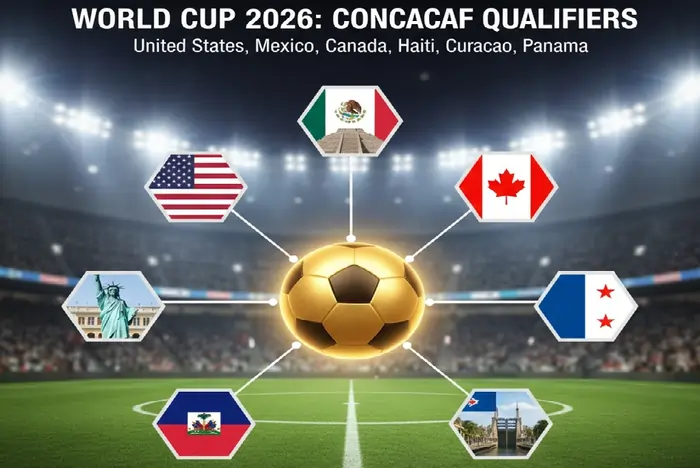
By late 2025, the list of CONCACAF nations bound for the World Cup in Canada, Mexico and the United States was complete. Six teams secured direct qualification, while two others booked playoff berths with a chance to join them.
Directly qualified CONCACAF teams for 2026:
For Curaçao, this represents a historic first‑ever appearance at a men’s World Cup, illustrating how the expanded format has opened doors for emerging football nations. Haiti’s qualification marks their return after last appearing in 1974, ending a decades‑long absence from the finals. Panama, which debuted in 2018, confirmed itself as a growing regional power by claiming another World Cup slot.
Two more CONCACAF teams—Jamaica and Suriname—qualified for the inter‑confederation playoff tournament. They will compete against representatives from AFC, CAF, CONMEBOL and OFC for the final two places at the World Cup, giving the region a realistic path to expanding its representation to eight teams.
Inter‑confederation playoff pathway
The inter‑confederation playoffs for the 2026 World Cup are a six‑team mini‑tournament that will be staged in the United States, within the host region. The participants are one team each from AFC, CAF, CONMEBOL and OFC, plus two from CONCACAF. These playoffs will decide the last two berths at the finals and serve as a high‑stakes dress rehearsal in host stadiums before the main tournament.
The format is seeded based on FIFA rankings:
- The two highest‑ranked teams receive byes into the final stage of the playoff bracket.
- The remaining four teams, including at least one CONCACAF side, contest two single‑match semifinals.
- The semifinal winners meet the seeded teams in two single‑match finals.
- The winners of those final ties claim the last two spots at World Cup 2026.
For CONCACAF, this structure is particularly valuable because it provides a competitive yet attainable route for teams like Jamaica and Suriname to reach the tournament for the first time or to return after long absences. It also ensures that the host region features prominently in the final qualification drama in the months leading up to the World Cup.
Hosts and regional spotlight
Canada, Mexico and the United States will each host matches, with a total of 16 cities across the three countries staging games between June and July 2026. Their automatic qualification allows them to focus on preparation, friendlies and continental competitions rather than navigating the qualifying gauntlet. As co‑hosts, all three will also shoulder the pressure of representing CONCACAF on home soil in front of global audiences.
The expanded allocation and host status also increase the probability of all‑CONCACAF matchups in the group stage and later rounds. Fans in the region can realistically expect to see multiple local rivalries, new World Cup debutants, and traditional powers all sharing the spotlight in familiar stadiums.
CONCACAF’s growing World Cup footprint
Historically, Mexico and the United States have carried most of CONCACAF’s weight at World Cups, with regular appearances and knockout‑stage runs. The 2026 cycle, however, showcases a broader base of competitive nations across North and Central America and the Caribbean, from Panama’s repeat qualification to Curaçao’s breakthrough and Haiti’s long‑awaited return.
With six direct places and two playoff slots, the confederation’s footprint at the 2026 World Cup will be larger and more diverse than ever before. That not only raises the profile of football across the region but also gives more national teams the experience and visibility that can help drive long‑term development at home. For supporters following along on The World Cup News North & Central America national teams hub, the road to 2026 is a chance to track both established giants and ambitious newcomers as they prepare for a historic home‑region World Cup.