
Asia Qualifiers
AFC national teams are entering the FIFA World Cup 2026 cycle with more opportunity and more pressure than ever before. With eight direct slots and one inter‑confederation playoff place, Asia’s qualification path is wider, but also far more demanding across every round. This page is your home for understanding how Asian sides qualify, who has already booked their ticket, and what tactical and structural trends define the region on the road to North America.
Asia’s road to eight (plus one) World Cup places
For World Cup 2026, the Asian Football Confederation (AFC) was allocated eight guaranteed spots and one playoff route, a huge jump from the 4.5 places used in previous 32‑team tournaments. All 47 AFC member associations entered a multi‑round qualifying system that doubles as the pathway to the 2027 AFC Asian Cup, turning every stage into a layered test of consistency, depth, and adaptability.
After early preliminary ties, groups in the second round filtered the field down to 18 teams. Those 18 nations then formed three groups of six, playing home‑and‑away in a demanding third‑round schedule where travel, climate, and squad management all mattered as much as pure talent. The top two sides in each of those groups – six teams in total – qualified automatically for World Cup 2026, while the remaining contenders moved into further rounds to fight over the last direct spots and the inter‑confederation playoff ticket.
The result is a qualification structure where Asian teams can play more high‑level competitive matches than ever before before reaching the finals, which tends to sharpen tactical cohesion and mental resilience.
Who’s in: the eight Asian qualifiers (so far)
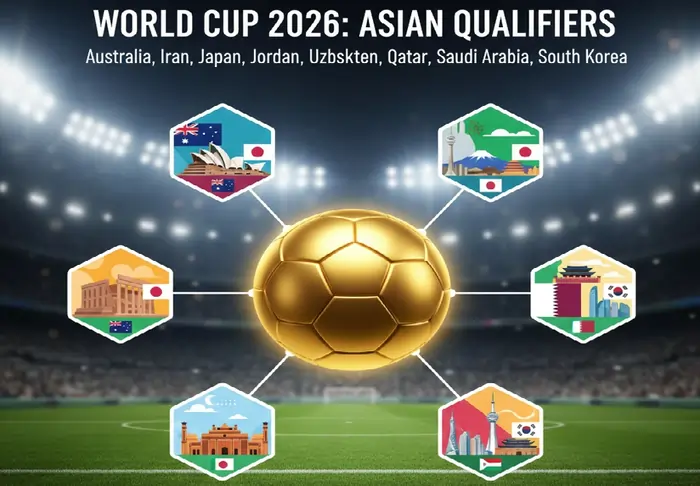
By late 2025, AFC’s eight guaranteed places had been filled, confirming one of the most diverse and competitive Asian contingents in World Cup history. According to FIFA and regional reports, Australia, Iran, Japan, Jordan, Uzbekistan, Qatar, Saudi Arabia, and South Korea have all secured their spots at World Cup 2026.
Japan became the first team in the world to qualify for the 2026 finals, sealing their place on 20 March and underlining their reputation as one of Asia’s most consistent performers at the global level. Iran, long a powerhouse in West Asian football, followed with another strong qualifying campaign built around compact defending and direct attacking transitions. South Korea extended their remarkable streak by clinching an 11th consecutive World Cup appearance, thanks to a decisive away win in Iraq during the third round.
Australia and Saudi Arabia added further strength from the Asian Cup regulars, bringing squads with a mix of European‑based players and domestic standouts. Qatar, recent Asian champions and hosts of the 2022 World Cup, also secured qualification, keeping themselves in the global conversation as a rising football nation.
The most historic stories, however, belong to Uzbekistan and Jordan. Both qualified for the men’s World Cup for the first time, turning long‑term potential into concrete achievement and expanding the map of Asian representation on football’s biggest stage.
Uzbekistan and Jordan: new names on the biggest stage
Uzbekistan’s qualification is a landmark moment for Central Asian football. A tense 0–0 draw away to the United Arab Emirates in Abu Dhabi was enough to secure second place in their third‑round group behind Iran, giving them an automatic spot at World Cup 2026 with a game to spare. Goalkeeper Utkir Yusupov produced several crucial saves, including a last‑minute stop, to protect the result and trigger celebrations that echoed the significance of a first‑ever World Cup berth.
Jordan, meanwhile, secured their debut World Cup appearance with a clinical 3–0 win over Oman in Group B, powered by a hat‑trick from Ali Olwan. Later results in the group confirmed that both Jordan and South Korea would finish in the top two, sending Jordan to the finals and validating years of incremental progress at regional level.
These two breakthroughs matter for more than just national pride. They demonstrate that AFC’s expanded allocation isn’t simply rewarding the same established names; it’s creating space for well‑structured, ambitious programs to rise and compete with the old order.
Tactical trends shaping Asia’s World Cup push
Beyond the qualification math, Asia’s national teams have used this cycle to show how quickly the region is evolving tactically. Match data and expert analysis point to three major trends:
Higher pressing and transition speed
Many Asian sides now apply more coordinated high and mid‑block presses than in previous cycles, forcing turnovers higher up the pitch and attacking quickly before defenses can reset. Teams like Japan, South Korea, Australia, and Saudi Arabia regularly shift between intense pressing phases and compact defensive shapes depending on game state and opponent.
Flexible shapes rather than rigid systems
The classic labels of 4‑4‑2 or 4‑3‑3 only tell part of the story. In possession, several leading AFC teams morph into three‑at‑the‑back structures to create overloads in midfield and wide areas, then drop into more conservative lines without the ball. This kind of tactical flexibility has helped Asian nations compete more effectively against diverse playing styles, from European positional play to South American transitions, both in qualifiers and high‑level friendlies.
Improved defensive compactness and game management
One of the main criticisms historically aimed at some Asian national teams was a tendency to lose shape late in games. Recent qualifying rounds suggest that issue is fading, with better spacing between lines, clearer pressing triggers, and smarter use of substitutions to protect leads. This is especially evident among teams that have paired domestic development with export of players to stronger leagues, improving individual decision‑making and physical standards.
Taken together, these trends mean that by the time AFC’s representatives reach North America, many will be used to playing high‑intensity, tactically complex matches rather than simply relying on raw physical effort or defensive deep blocks.
Why Asia’s expanded presence matters at World Cup 2026
World Cup 2026 will be the first men’s World Cup with at least eight Asian national teams guaranteed in the final tournament, with a ninth potentially joining via the inter‑confederation playoff. That scale of representation changes the texture of the tournament: more AFC vs UEFA and AFC vs CONMEBOL fixtures in the group stage, more regional match‑ups, and more opportunities for Asian players and coaches to test themselves against the world’s strongest football cultures.
It also has long‑term implications for the game’s growth. Every additional World Cup appearance feeds into grassroots interest, sponsorship, infrastructure, and domestic league development back in each qualifying country. For first‑time qualifiers like Uzbekistan and Jordan – and historic achievers like Cape Verde in Africa – a single tournament can accelerate an entire footballing ecosystem.
At the same time, the expanded allocation brings new expectations. Established powers like Japan, South Korea, Iran, Australia, Saudi Arabia, and Qatar are no longer judged simply on whether they qualify; their campaigns will increasingly be measured by how far they advance and how competitive they are against top‑ranked opposition in the knockout rounds.
Follow every AFC national team story
This Asia (AFC) hub at The World Cup News is built to help you track that entire journey in one place. Here you’ll be able to:
- See which Asian national teams have qualified and how they got there, round by round.
- Understand how AFC’s 8.5‑slot structure works and why it produces such intense qualifying campaigns.
- Learn the tactical identities of major sides and debutants, from Japan and South Korea to Uzbekistan and Jordan.
- Watch how Asia’s representatives prepare for the challenge of playing in North America’s stadiums, climates, and time zones at World Cup 2026.
As new results come in and squads are finalized, this page will link you to deeper profiles, match analysis, and tournament‑time coverage for every AFC national team heading to the biggest World Cup the sport has ever seen.